|
Mad Rabbit Update The Mad Rabbit 30-day comment period ended Wednesday, November 23rd, right before Thanksgiving. We are thankful each year to be living in Routt County with its abundance of wildlife and backcountry. This Thanksgiving, we are particularly thankful for all those who stood up when Routt County wildlife was threatened. All those who wrote comments, spoke to their neighbors, and influenced their friends. All those who volunteered and donated. All those who wrote letters to the paper. We are truly blessed by Routt County’s wildlife and wild places, along with a diverse community willing to protect them. The conservation ethic in Routt County runs deep. We hope all of you had a happy Thanksgiving surrounded by family and friends. There were seven well-reasoned letters to the editor opposing Mad Rabbit and none in support. We’ve posted links to all seven on our “What Are Routt County Locals Saying?” page here: https://www.keeprouttwild.com/locals-letters We submitted our own comments on the final day. You can read them here. You will see that they have been submitted by our legal team from KKR. Our attorneys, Bob Randall and Brandon Rattiner, are experts on NEPA law and the Colorado Roadless Rule. Bob Randall has a particularly relevant history in this regard. While he was Executive Director of the Colorado Division of Natural Resources under Governor Hickenlooper, he shepherded the US Department of Agriculture’s adoption of the Colorado Roadless Rule and is regarded as the rule’s foremost expert. The Colorado Roadless Rule protects 4.2 million acres of roadless National Forest lands in Colorado, including the Long Park Roadless Area where most of Mad Rabbit development is targeted. Our comments address the Colorado Roadless Rule, and the multiple ways the proposed action violates it. Our comments also lay out, in an almost tedious surgical fashion, the threat that Mad Rabbit represents and the way the Forest Service has ignored the National Environmental Policy Act, the Colorado Roadless Rule, best available science, and their own best practices. Our comments dismantle the Forest Service’s major talking points about US40 buffer distances, highlight their use of an obsolete habitat model from 1983 in their impacts analysis, and take issue with their novel approach that removing illegal trails should allow them to develop more impactful recreational trails. We showed where they misunderstood other Forest Service studies and presented assertions without any backup evidence. We then showed the evidence to the contrary. You can read these comments at your leisure. Keep Routt Wild presented evidence with detailed scientific backup. In partnership with Rocky Mountain Wild, we performed a spatial habitat analysis based on respected Forest Service studies. We showed how elk calving areas and summer range are severely impacted by the cumulative impacts of the proposed action. This is an incredible analysis that combined Mad Rabbit geospatial data, the geospatial data of all previous roads and trails in the project area, CPW-indicated elk calving and summer range, and the previously mentioned Forest
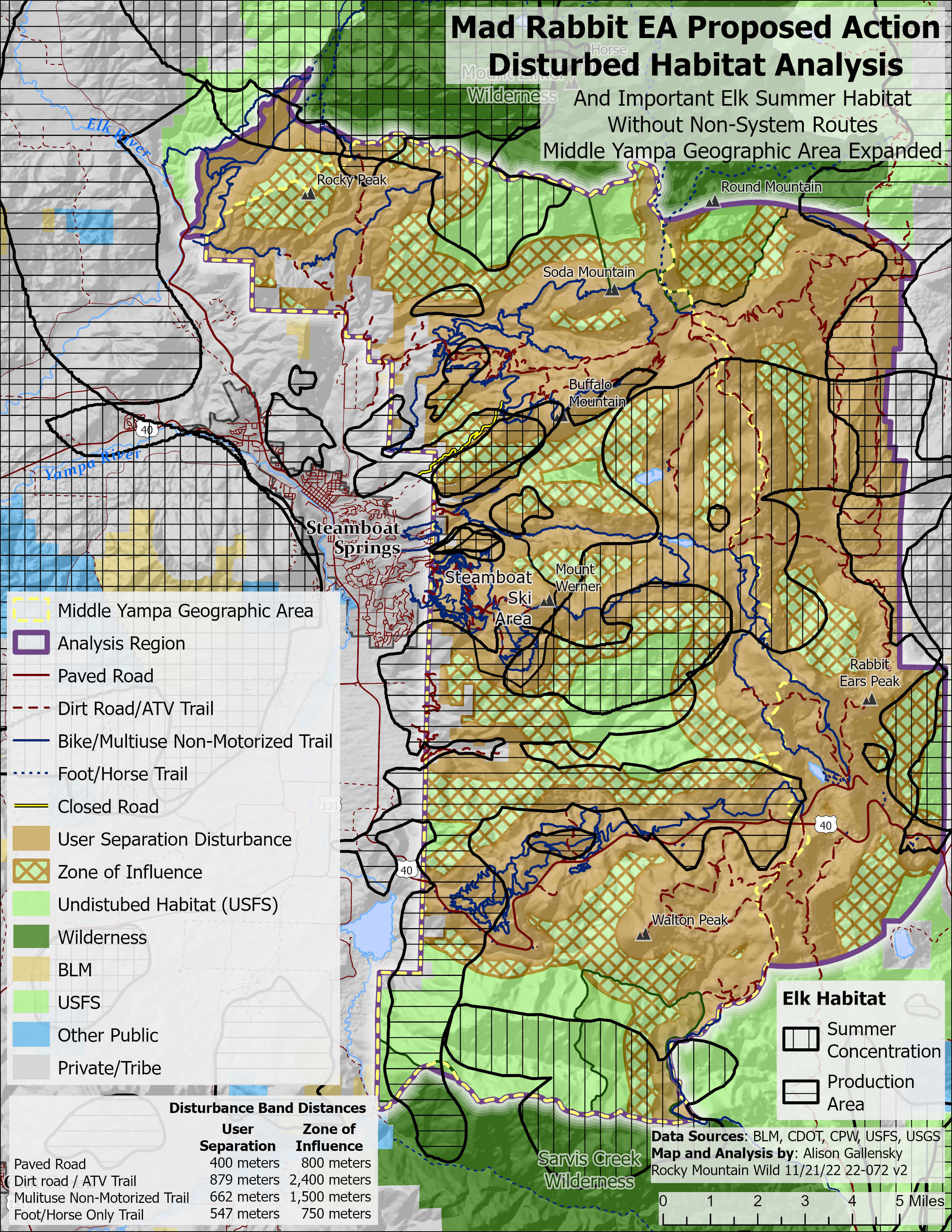
Service peer-reviewed studies. Together they show the
impact to elk habitat, and it’s not pretty. You can view a high-resolution image of our analysis here. We will place a lower resolution image in our newsletter below. It shows how existing trails are in some of the most sensitive elk habitat. It shows how habitat is fragmented. And it shows that when Mad Rabbit is added, there’s a loss of an additional 4,000 acres of habitat representing 7% of the remaining total. We continue to offer our compromise proposal. It’s a proposal that increases recreational trail opportunities with minimal impact to wildlife. It involves endorsing some trails, eliminating others, and moving some trails out of sensitive areas. You can read our compromise proposal here. Our analyses, represented in the comments, show the importance of Keep Routt Wild’s engagement here. It’s another reason why we ask you to support us this Colorado Gives Day. The question is “what now?” In the normal process, the Forest Service reviews the comments and responds with its final analysis and decision on the proposal or with a determination that further analysis is needed. This could take months, or even a year. In the meantime, we’ve presented an alternative that should be given careful consideration. Stay tuned.
|